Saturday, 19 January 2013

9. Harvard Business Review Article – In a Downturn, Provoke Your Customers by Philip Lay, Todd Hewlin, and Geoffrey Moore


To get the year rolling, B2B Books has chosen this short article from the Harvard Business Review. In a Downturn, Provoke Your Customers, offers an alternative and fresh perspective on sales acquisition during hard economic times. Solution Selling is directly challenged as a somewhat antiquated niche sales methodology, which does not work well enough in all scenarios.

Provocation selling follows a series of stages:
  1. Identify a critical issue – great in depth company research to know company inside out and hence identify a strategic issue the sales professional’s company can address.
  2. Formulate your provocation – create an original point of view that will stimulate interest from C-Level decision makers. 
  3. Lodge your provocation – develop a presentation that demonstrates and clarifies the specific challenge faced by the company. Additionally, establish the sales professional’s deep understanding of the company.
  4. Prove your point – a diagnostic study to investigate the challenge illuminating related issues and gaining internal momentum for continued problem resolution.


When considering solution selling the notion is to aid clients to articulate existing problems and the implications of those problems as they align with the solution to be presented. In contrast, Provocation selling requires the presentation of an impactful problem statement that challenges the prevailing point of view and which the sales professional has developed base upon in depth research and analysis accomplished on the target company.  

Given that Provocation selling is aimed at the C-Level the initial challenge of the status quo is directed at overall business strategy and needs to be handled with a delicate confidence which inspires further budget for examination of the issues facing the client. Moreover, and this is quite interesting, the level of interest garnered from a skillfully delivered presentation should result in a revenue stream to accomplish an in depth analysis of the issue within the company. This is turn puts the sales professional in a C-Level sponsored leadership and influence role to force even more issues to the surface and entrench him in the account as a trusted advisor.

Looking at the article as a whole, Provocation selling requires an immense amount of time intensive research to gain the necessary knowledge to lodge an impactful challenge. This method is definitely structured toward enterprise level companies lacking sufficient budget for new endeavors. It would be well suited to long-term sales cycles of companies who sell strategically critical products from the C-Level perspective. 

Thursday, 3 January 2013

8. Drive: The surprising truth about what motivates us. By Daniel H Pink.

The book examines intrinsic and extrinsic motivation in the business world today putting forth the notion that most businesses have a reward system that is directly in conflict with what truly motivates people.

Drive begins with an examination of motivation over the past 100 years defining different levels of motivation and their relevance in the business world. Pink is quick to point out that research accomplished in motivation is in direct conflict with practises in the business world of the past and present. He labels three levels of motivation as 1.0, 2.0 and 3.0 with the last being the pinnacle of intrinsic motivation.

With the notion of Motivation 3.0 being the best source for a company to tap, Pink examines how typical carrot and stick reward strategies algorithmic and heuristic tasks. He is careful to state that this kind of reward system works well in algorithmic task, but fall very short for heuristic tasks. There are some great examples of companies, for instance Google,  who seek innovation targeting Motivation 3.0 via allowing 20 percent of employees time to focus on personal interest tasks related to their job.

The book delves deeper into personality types and three elements of great motivation; autonomy, mastery and purpose. While this section does draw you in, once completed the rest of the book completely leaves you wanting. The last third of this book is almost worthless as it does little to expand upon a great first two thirds. To put it simply the research on motivation is outlined and exemplified, followed by a foundation of creating personal motivation and then nothing.

Wednesday, 12 December 2012

Drive - Reflections 1

A few thoughts to play with.

As I sit reading this book, Drive: The surprising truth about what motivates us, I am not struck by the initial message in the book that intrinsic motivation in business is lost or is at least not as pervasive as it needs to be. However, since then, I can not stop thinking about how motivation relates to my sales career, my colleagues and the higher-ups in all organizations influence on motivation.

Looking into myself, I ask what is at the core of my motivation in sales? How does this impact my daily routine? What value is there in sales teams where motivational cores are disparate? How do I maintain personal motivation in this situation?

Going a few pages further I am confronted by the idea of sales being a heuristic task rather than a algorithmic task. A heuristic task requires creativity while an algorithmic task is straight forward requiring no creativity. The former tends to provide great motivation in the workplace with that motivation adversly impacted by algorithmic rewards. As Pink states, "External rewards and punishments can work nicely for algorithmic tasks but they can be devastating for heuristic ones." My mind boggles at the fact that solution or consultative sales of high complexity are heuristic tasks which are monitored by management who employ primaralyextrinsic algorithmic reward models.

Sunday, 23 September 2012

The 7 Habits of Highly Effective People


7. The 7 Habits of Highly Effective People

The 7 Habits of Highly Effective People begins by examining perception and motivation of the individual. It seeks to alter our perception to think outside the paradigms of conventional thought. It examines motivation from the point of personal principles that drive behavior. In so doing Covey plants the seed that we can change and sets the stage to address these concepts in more detail later in the book.

An ongoing theme of the book is the P / PC balance. The P is defined as production and the P / C defined as production capacity. Production is the result of one’s labours and does not always mean something positive. The example given by Covey, is the Goose and the Golden Egg. However, in his version of the tale the farmer cuts open the goose to get all the golden eggs inside. Of course he finds that there are no eggs leaving him with a dead goose. The golden eggs in this story represent the P while the goose represents the P/C. The lesson to learn here is to focus on P/C that creates a balanced P whether it is in life, school, or business.

Throughout the book Covey comes back to the P P/C balance, but the core of the book is the seven habits of highly effective people. None of these habits stand alone; rather they are grouped in to sections of private victory (1-3), public victory (4-6) and renewal (7). The habits are briefly summarized here.

1.       Be proactive

Our power is the ability to control how we react to our environment. We can choose to focus on the aspects of life that we have control over and use that choice to exert influence outwards. This is in stark contrast to focusing on areas we have no control over and hence influence comes from the outside in.

2.       Begin with the End in Mind.

This habit is about getting organized. Prepare a personal mission of purpose and direct actions to its achievement. There is a heavy focus on learning about personal principles already in existence which drive behavior.  This understanding of personal principles empowers us to be ourselves in the achievement of our mission. .

3.       Put first things first.

The crux of this skill is the Time Management Matrix which characterizes actions as urgent or not urgent, and important versus not important.  It pushes us to stay focused on the actions which will achieve the greatest results and extends some planning strategies in order to reach a high level of personal management.

4.       Think win/win.

This is an exercise in lateral thinking which results in both parties getting the most out of a relationship. It is based upon levels of courage and consideration regarding relationships to surpass expectations on both sides.

5.       Seek first to understand, then to be understood.

This skill is all about listening and listening beyond the likes of active or reflective listening. It is clarifying and re-clarifying. It is putting that person’s message over and above yourself and any stakeholder in order to have a complete and utter understanding of their message and their perspective in the creation of that message.

6.       Synergize.

This entails not just overachieving in goals, but overachieving in the goals, in the process to achieve those goals, and in the personal development of each and every team member.

7.       Sharpen the saw.

All of us have physical, mental, spiritual and social/emotional dimensions in life and work. These dimensions are not mutually exclusive of one another and each requires specific attention to achieve personal balance, a deficiency in one surely impacts another so take care of yourself.

Personal Review.

I took a lot out of this book and will continue to do so as I develop my own personal mission.  That being said, the two most impactful messages for me were; Seek first to understand and to Sharpen the Saw. Regarding the former, I found myself wondering if I was really listening to understand. Then I found myself pushing my thoughts and feelings to the side in order to really listen. Afterwards, I noticed more trust from those I really listened to.

Sharpen the Saw was the surprise skill of the book. So often business books neglect to think about the whole package of what makes a person effective. We really need to take care of every part of our lives in order to be effective. Not taking care of things at home impacts work and vice versa. All work and no leisure time its toll on the body and the mind.  It was very refreshing to come to the end of the book with a message to take care of yourself in following the principles of this book.  

The 7 Habits of Highly Effective People, is a book about life. It transcends the applications of most business books firmly establishing an individually centred approach to becoming an effective person in your personal or business life. In fact, it was quite remarkable how this book surfaced in so many different aspects of my life. Of course this book was chosen by members of my book club, some who had already read it and wanted a refresher. It also surfaced at my daughter’s school when each and every teacher read the book and developed a program around their specific grade to increase leadership skills. It appeared in the hands of my wife who found some of the points made in the book so alluring she picked it up and did not put it down. This book certainly carries a lot of relevant weight in a diverse array of people and is one that I recommend you pick and read from cover to cover.


Wednesday, 6 June 2012


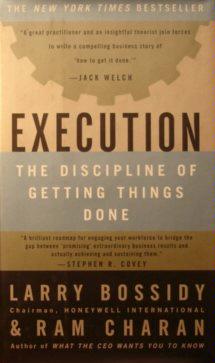
6. Execution: The Discipline of Getting Things Done
Execution: The discipline of getting things done, presents the behaviors and processes for leaders of enterprise sized companies to become successful at execution of C-level business strategy.  It also takes the time to exemplify the behaviors and processes within C-level leadership in North American companies. Larry Bossidy and Ram Charan take readers on a journey showing where execution was carried out impeccably and where it was carried out with less success. The examination begins with seven essential behaviors of strong leadership which are followed by the three core processes of execution.

To let you know a bit about the authors, Larry Bossidy had illustrious careers with General Electric and Allied Signal which later became Honeywell. Ram Charan has been a full-time consultant since 1978 working with such companies as General Electric, the Bank of America and KLM. Both of these experienced professionals use their considerable experience and knowledge to bring light to the essential characteristics of a leader and the core processes of execution.
The seven behaviors of a leader outlined in this book are:
-          Know your people, know your business.
-          Insisting on realism
-          Set clear goals and priorities
-          Reward doers
-          Expand capabilities
-          Know yourself

Having leaders who typify these behaviors is critical to ensure the success of a company, its people and in turn its shareholders. In the book, these characteristics are linked to a certain characteristic – that being, emotional fortitude. To be able to consistently exert these behaviors a leader must have the emotional fortitude to carry the weight of decision making that may not be most pleasant, but leads to the best outcomes. A leader must be able to face the realism of a failing strategy as much as the success of a company. He must be able to set clear goals and priorities for all levels of a company. He must be able to discern between the real doers and those who appear to be doers. He must be able to pull the best out of his people in the toughest of times. And last he needs to be able to look in the mirror seeing both his strengths and his weaknesses.
The three Core Processes are:
-          The People Process
-          The Strategy Process
-          The Operations Process

Each of these is tied very well, not only to one another, but the foundation of the seven essential behaviors of a leader as well. These processes are described in detail from the perspective of candidates for CEO and the CEO position itself. The writers experience at this time really shines through as the necessary actions to achieve a culture of execution in people, strategy and operations is dealt with in great detail. An ongoing theme that was echoed throughout the book is one of vigorous debate which was highlighted in each section – vigorous dialogue to find the right people, vigorous dialogue to pursue the right strategy and vigorous dialogue to ensure the right operational process.
The book ends with a great fictional letter to a new CEO about to take on her new position. This letter is a brilliant conclusion tying together all the points made throughout the book. It takes a motivational read on how to execute and ties it neatly together with a believable vision.

The B2B Discussion of Execution: The discipline of getting things done
The discussion of this book was, to say the least, was a vigorous dialogue which focussed on two main areas; first, how the book helped us professionally and two, how it mirrored our own experiences in and supporting leadership roles.
In regard to how this book aided members professionally, the discussion centered in on the seven essential behaviors. Members looked at the seven essential behaviors and asked, “How well do I exemplify these behaviors?” Each member went on to consider specific behaviors that were in need of improvement.  This was particularly illuminating as all felt improving upon these behaviors would dramatically improve performance.
There was great debate of leaders in all members past and present careers in comparison to the seven essential behaviors and the core processes. A great deal of time was spent in the application of the book’s theory to constructively criticising leader’s successes and failures.  In the end, answers were found, but moreover, the need of emotional fortitude and vigorous dialogue   in relation to the essential behaviors and core processes held true. All members would recommend the book to a colleague.

Thursday, 3 May 2012


5. Hope is Not a Strategy – The Six Keys to Winning the Complex Sale  
Hope is Not a Strategy, came highly recommended by several business colleagues. The book takes aim at six keys to winning the complex sale those being; 1. Link Solutions to Pain, 2. Qualify the Prospect, 3. Build Competitive Preference, 4. Determine the Decision-Making Process, 5. Sell to Power, 6. Communicate the Strategic Plan.

From the perspective of B2B Books the book delivered on a micro-level, but not a macro level. To be more precise, it delivered on inspirational and thought provoking ideas and actions found in each of the six keys, but failed to deliver on succinctly describing, a “single, simple, strategic process for winning sales and dominating accounts. Let us have a look at both of these aspects of the book in turn.
Throughout Hope is Not a Strategy, there were numerous nuggets of content which spurred great thought on different parts of the sales cycle. Something important these nuggets related to different members in varying degrees. Members found it hard to put the highlighter down due to the plethora of relevant statements to their sales cycle and approach to sales. This happened so often that members often put the book down to deeply consider the ramifications of a sentence or passage.
One such idea was a simple question regarding, Key 4: Determine the Decision-Making Process, “If the client was going to make a decision today, what would it be?” The answer to this question clearly indicated that action needed to be taken in order to maintain a yes answer or to change a no or no decision answer. For instance, some actions might be the engagement of resources to move a decision in one’s favour. It could also suggest that the decision making process must be better understood in order to apply the correct strategy. This could entail the engagement of different advocates inside the client’s organization, the invoking of better strategy or the rallying of internal resources. Whichever the case this question should always be top of mind in the complex sale as it maintains the focus on the negotiating with the right decision makers and the obtaining of business from a client.

Another great concept found in Hope is Not a Strategy, is steering the sale. A salesperson should always endeavor to steer the sale which implies they are in control. He or she is the one leading clients to the best solutions for their business’s ailments. This should happen from the beginning of the sales process. Consider this example from the book. If a salesman has received an RFP, but had not played any part in defining the requirements therein.  Understand that someone did and whether it was an internal or external player who defined those requirements, it was not the salesman and this puts him or her at a disadvantage. 
Moving on, Hope is Not a Strategy, claimed it would convey a single, simple, strategic process for winning sales and dominating accounts. This simplification was sorely lacking in a cohesive and coherent description of a single process. Each chapter dedicated to a specific “key” to the complex sale stood alone. Inside each of these chapters there were extended descriptions with diagrams to provide a clear picture of a “key” process. These diagrams did not provide a clear picture of process neither for the chapter in question nor an overall, all-encompassing process. In fact, the diagrams created more confusion than clarity in B2B Books members.
That being said, there was clarity found in the grey callout boxes where descriptions of each of the “keys” to the complex sales. B2B members were quick to point out how these examples were the best source of clarification in each chapter. Still, they were not enough to pull the six keys to the complex sale into a clear process.
In summary, Hope is Not a Strategy biggest strength lies in its ability to relate to sales professionals in the specific ideas, actions within the “keys” to achieving success in the complex sale. As an overall approach there is no clearly defined model or process for winning the complex sale. The end result is a worthwhile read that stimulates sales professionals to adopt particular action(s) as it relates to their personal approach to the complex sale. In so doing, a salesperson can hone their activities in their approach to the complex sale; however, there is little chance of developing a single approach to the complex sale.

Saturday, 7 April 2012


4. SPIN Selling


Backed by empirical field research with hundreds of actual real sale’s call observations, Spin Selling brings to light what offers the best chance of success in large sale scenarios. Authored by, Neil Rackham, the book moves through the questioning techniques used by successful and unsuccessful sales professionals in both small and large sales and via observation of their sales calls, develops an overall approach for large sales.
Neil Rackham, tackles his “Spin Selling” approach via a careful review of his field research. In this formal account, he recounts his experiences with sales professionals at different levels and the sales techniques employed to get the sale. He first considers the process of gaining a sale and the impact of various closing techniques in small and large sales. He also considers the necessary level of commitment from buyers in small and large sales.
Moving on, Rackham gets into the primary focus of his research – the SPIN Model. The SPIN model is all about questions, those being Situation, Problem, Implication and Need-payoff questions. The main theme to take note of is that sales professionals should be listening more that talking.  The right questions delivered in the correct manner lead to obtaining the best information which, in turn, lead to the biggest payoff for the client. This most positively impacts the success of a sales call. During this portion of his book he also attempts to debunk many of the popular theories on how questions are used during sales calls. There is an analysis of the above mentioned questions types going into detail on how each statistically contribute to the success or failure of a large sale.
The second half of the book examines the application of the SPIN Selling Model as it pertains to avoiding objections, presenting benefits and advantages and opening the call. The freedom of the SPIN Model is accentuated during this portion of the book with Rackham careful to point out that the model is meant to be flexible enough to follow the dynamic nature of sales calls. Once again, the main focus is that each question type has a specific purpose and impact on the success of the sale. It is vitally important not to be drawn into presenting benefits or advantages as they deal with surface level objections to early in a sales call. It is more important to dig deep into the reasons and implications of objections via the SPIN Selling model. In so doing one can attend to objections at the root and moreover have clients assign specific pay-offs to implications.
Finally, the book ends with a method of turning theory into practice which is quite refreshing. Rackham fully acknowledges that becoming an expert SPIN seller is a long process, furthermore outlining some simple steps to move toward proficiency. The steps are easy to accomplish and the sale professional is encouraged to focus on quantity of quality, to try new behaviors at least three times and to practice in safe situations. The simplicity of these steps to learning is magnificent as it is definitely easy to apply. Something added to the learning process is the idea of plan, do and review. This lends strength to the adoption of SPIN Selling.
Looking at the book as a whole, the B2B book club thoroughly enjoyed this book’s approach to selling. Members focussed heavily on the movement from Implication questions to Need-payoff questions and how to facilitate this movement.  A question brought up was in regard to what we termed as filters. Filters we defined as the barriers clients raise preventing free communication between the salesman and the client.  Each member agreed that resistance is common during all sales calls and that there are moments during the call when these filters are dropped resulting in a higher level of engagement between the two parties.  The question surrounding the SPIN Selling model became, “Which type of question best serves to remove the filters of clients?”  A long discussion of personal examples did not lead to a firm conclusion but a thought. Well placed implication questions tend to engage sellers the most as they are most intimately related to their business.
SPIN Selling, in the end, is a favorite of B2B Books with each member finding great benefit in reading the book. Personally, I also found great value in the content and will get a copy of the SPIN Selling fieldbook to further investigate the model in practice.  Should you wish to purchase the book follow the links below.  All the best!
SPIN Selling
SPIN Selling Fieldbook